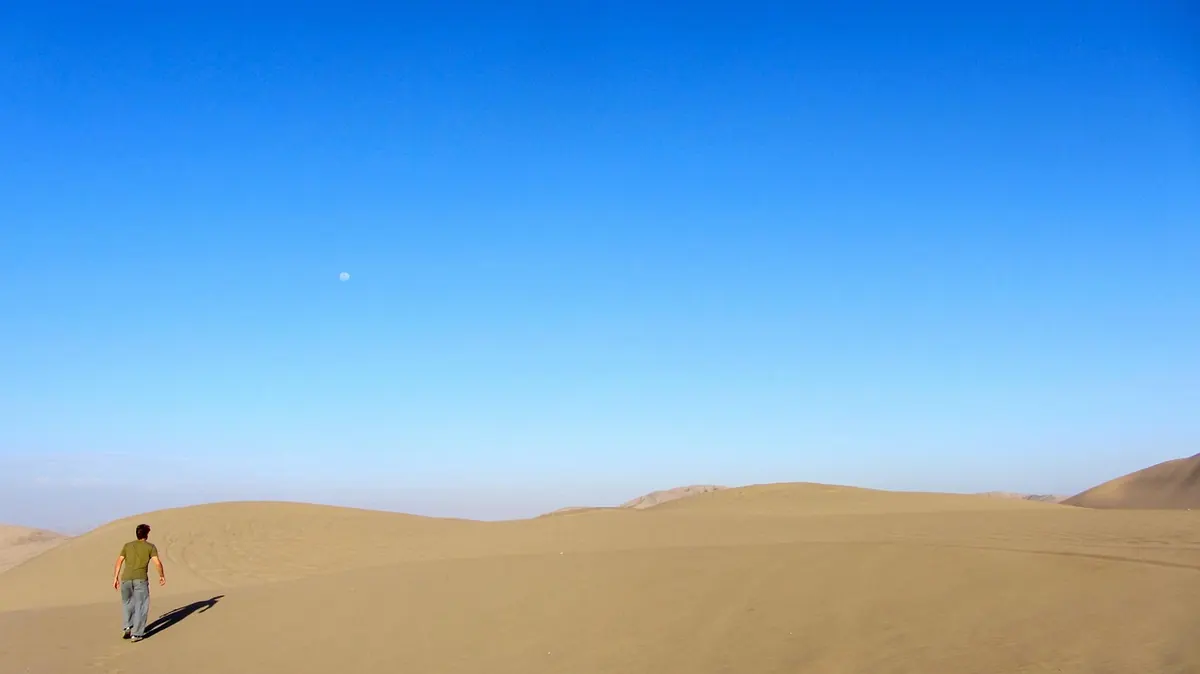
You can learn a great deal about a dune before your tyres touch it. The shape alone tells you which way the wind blows, where the sand is firm, where it is loose enough to swallow a wheel, and what is likely to be waiting on the far side. Most of what goes wrong out there — a car bogged to the sills, a climb that stalls halfway, an unpleasant surprise over a crest — was visible in the dune's silhouette ten minutes earlier. Reading that silhouette is a skill, and like any skill it is learned by looking rather than by hoping.
The four parts you need to name
Dunes vary enormously, but almost all of them share the same basic anatomy. Learn the names and you will start to see the logic of the landscape.
The windward slope
This is the long, gentle side that faces the wind. Because wind has been pressing on it, the sand is generally packed and firmer than you would expect. Gradients are usually modest, and this is almost always your approach line rather than a place to cross.
The crest
The crest is the sharp line along the top, where the windward slope ends and the drop begins. Sand here is often the loosest on the whole dune, and it is the point at which you lose sight of what lies beyond. Treat it with respect.
The slip face
The lee side, sheltered from the wind, collapses under its own weight until it settles at roughly thirty degrees or a little more. That steepness is why it feels so different to drive: the surface is loose, unsupported and constantly shifting. Climbing a slip face is rarely a good use of fuel.
The flanks and plinth
The shoulders at either end and the apron of sand around the base are usually firmer, scoured by crosswinds and often crossed by wind-blown ridges. They make useful entry and exit routes when a direct line is blocked.
Which way is the wind blowing?
Dunes point downwind. The long, gentle slope faces the wind; the short, steep drop is in its shelter. So if the long slope runs in from the east and the slip face tumbles away to the west, the prevailing wind is coming from the east. That single observation tells you which side will be firmest, which side will be softest, and how the sand is likely to behave under load.
Ripples give you a second clue. They form at right angles to the wind, and their texture says a lot about the surface. Fine, tight ripples generally mean sand that has been packed and settled. Coarse, crumpled or powdery tops mean it has not.
Firm or soft? Reading the surface
- Colour. Dull, darker sand is often damper and firmer. Bright, pale sand is dry and loose.
- Texture. If the surface looks crisp and ribbed, it will usually carry you. If it looks fluffy, plan for more wheelspin and more momentum.
- Vegetation. Scrub and grass mean the sand has held long enough to root, so it is generally stable, though roots near a crest can be brittle.
- Old tracks. Wind-healed tracks show where others have crossed and usually mark a firm line. Fresh, churned tracks are looser than the sand around them.
- Light. Low sun, early or late, reveals the shape of a dune far better than flat midday glare. If you are reccing an area, go when the shadows are long.
Judging the approach
Momentum matters more than power. A steady, deliberate build in the right gear will get you further than a late burst of throttle, and sand punishes sudden steering inputs by stealing the speed you just spent.
- Pick your line before you commit to it, ideally on foot.
- Look at the far side. The most common mistake is climbing without knowing what is over the top.
- Choose the longest, gentlest gradient available rather than the shortest.
- Check the crest for a lip or a step. A rounded edge gives a smoother transition; a sharp one will launch you.
- Approach straight rather than at an angle unless you have walked the traverse and know it holds.
Reducing tyre pressures increases the footprint of each tyre and helps the vehicle float rather than dig, but the right figures depend on the vehicle, the load and the conditions, so check your handbook and take local guidance before you let air out.
Crossing the crest and choosing a descent
Cross a crest square and straight. Turning on a crest is where rollovers happen: the sand is loose, the surface changes beneath you, and the far side is often steeper than it appeared from below. Once you are over, commit to the descent line you have already chosen.
- Point straight down the fall line with the wheels straight.
- Select low range and a low gear, and let engine braking control your speed.
- Avoid braking mid-slope where you can. Braking can dig the front wheels in and pitch the nose down.
- Do not coast or ride the clutch. Keep the drivetrain connected.
- Steer only once you are on the flat. A turn on a slip face starts a slide that is hard to catch.
Undercuts and invisible edges
Wind does not only build dunes, it eats them. On the sheltered side of a ridge you will often find an undercut: an overhanging lip of sand with nothing beneath it. From above, it looks like solid ground. This is one more reason to walk a new crest, particularly where two dunes meet and the ground funnels between them. Where sand sits beside rock, gravel plains or vegetation, it thins quickly, and a smooth-looking slope may hide a hard plinth or a gully behind it.
The five-second read
Before you point the nose at any dune you have not driven, run through these questions. If you cannot answer all of them, stop and walk it.
- Which way does it face? The long, gentle slope is the approach.
- Where does the slip face drop, and how steeply?
- Is there an undercut or a sharp lip on the crest?
- Is the surface firm or fluffy?
- What is beyond the crest — flat ground, another drop, a bush, a rock?
- Do you have a clear descent line and a way out if it goes wrong?
Sand rewards judgement, not bravery. Conditions change through the day too: ground that was firm in the cool of the morning can be soft and churned by mid-afternoon, and after rain a dune may drive beautifully for a while before drying into an unpredictable crust. Drive with others where you can, take local advice on areas you do not know, and build your eye one dune at a time. The drivers who look effortless out there are simply reading the sand a little earlier than everyone else.
Photo: derbocholter / Pixabay